
 Lauren Teukolsky’s “Wage and Hour Case Notes” were published in the July 2024 edition of the CLA California Labor and Employment Law Review. Her column describes five recent decisions from California’s Supreme Court and appellate courts that affect wage-and-hour law. Among the decisions are rulings regarding minimum wage for pretrial detainees, arbitration agreements that exclude PAGA claims, and the standard for awarding penalties for inaccurate paystubs.
Ms. Teukolsky’s column also discusses whether employees without individual PAGA claims have standing to pursue PAGA claims on behalf of others, and whether employers waive their right to arbitration of individual PAGA claims if they do not move to compel arbitration in a timely manner. CLA (California Lawyers Association) is a voluntary statewide bar association. Its mission is to “promote excellence, diversity and inclusion in the legal profession and fairness in access to justice and the rule of law.” Ms. Teukolsky was recently appointed to serve on the Executive Committee of CLA’s Labor & Employment Section. Her three-year term starts in October 2024. Ms. Teukolsky has written for CLA’s California Labor and Employment Law Review for over two years. Her “Wage and Hour Case Notes” are published on an alternating quarterly basis. Wage-and-hour law is an ever-evolving field with frequent rulings that regularly reshape the legal landscape. Ms. Teukolsky has navigated those rulings for over 20 years and is an expert in both state and federal wage-and-hour law. She speaks frequently on wage-and-hour topics at national and state conferences and is regularly quoted by media outlets for her insights on the topic. To read Ms. Teukolsky’s article in its entirety, click here. If you would like to speak with Ms. Teukolsky about a wage-and-hour matter, click here.
0 Comments
 Earlier this week, Lauren Teukolsky was appointed to the California Lawyers Association (CLA) Labor & Employment section’s Executive Committee. CLA is a statewide bar association with a mission to “promote excellence, diversity and inclusion in the legal profession and fairness in access to justice and the rule of law.”
The Executive Committee for CLA’s Labor and Employment Section plays a vital role in carrying out the sections’ basic functions in addition to collaborating on delivering programs, publications, services, and benefits to section members. Executive Committee appointees are nominated by current Executive Committee members. Appointees are evaluated for their accomplishments and their proven commitment to volunteer work that demonstrates a commitment to public service, among other criteria. Ms. Teukolsky regularly contributes to CLA’s California Labor and Employment Law Review, where her “Wage and Hour Case Notes” are published on an alternating quarterly basis. Ms. Teukolsky’s three-year appointment on the Executive Committee will begin on September 8, 2024.  Lauren Teukolsky’s “Wage and Hour Case Notes” were published in the March 2024 edition of the CLA California Labor and Employment Law Review. Ms. Teukolsky’s column describes three recent decisions from California and federal appellate courts that affect wage-and-hour law. Among the decisions are rulings regarding trial courts’ authority (or lack thereof) to strike “unmanageable” PAGA claims, and whether a policy requiring employees to remain on work premises during rest breaks merits class certification.
CLA (California Lawyers Association) is a voluntary statewide bar association. Its mission is to “promote excellence, diversity and inclusion in the legal profession and fairness in access to justice and the rule of law.” Ms. Teukolsky’s “Wage and Hour Case Notes” are published on a quarterly basis by CLA’s Labor and Employment Law Section. Wage-and-hour law is a dynamic field with new appellate decisions that regularly reshape the legal landscape. Ms. Teukolsky has navigated those appellate decisions for over 20 years and is an expert in both state and federal wage-and-hour law. She speaks frequently on wage-and-hour topics at national and state conferences and is regularly quoted by media outlets for her insights on the topic. To read Ms. Teukolsky’s article in its entirety, click here. If you would like to speak with Ms. Teukolsky about a wage-and-hour matter, click here.  Lauren Teukolsky’s “Wage and Hour Case Notes” were published in the November 2023 edition of the California Labor and Employment Law Review. Ms. Teukolsky’s column describes seven new decisions from California and federal appellate courts that affect wage-and-hour law. Among the cases are significant rulings regarding reimbursements for pandemic era work-from-home expenses, arbitration exemptions for transportation workers, time entry rounding, and one of the first appellate applications of Adolph v. Uber, among other topics.
Wage-and-hour law is an ever-changing field with new appellate decisions that often reshape the legal landscape. Ms. Teukolsky has navigated those appellate decisions for over 20 years and is an expert in both state and federal wage-and-hour law. She speaks frequently on wage-and-hour topics at national and state conferences and is regularly quoted by media outlets for her insights on the topic. The California Lawyers Association (CLA) is a voluntary statewide bar association. Its mission is to “promote excellence, diversity and inclusion in the legal profession and fairness in access to justice and the rule of law.” Ms. Teukolsky’s “Wage and Hour Case Notes” are published on a quarterly basis by CLA’s Labor and Employment Law Section. To read Ms. Teukolsky’s article in its entirety, click here. If you would like to speak with Ms. Teukolsky about a wage-and-hour matter, click here. 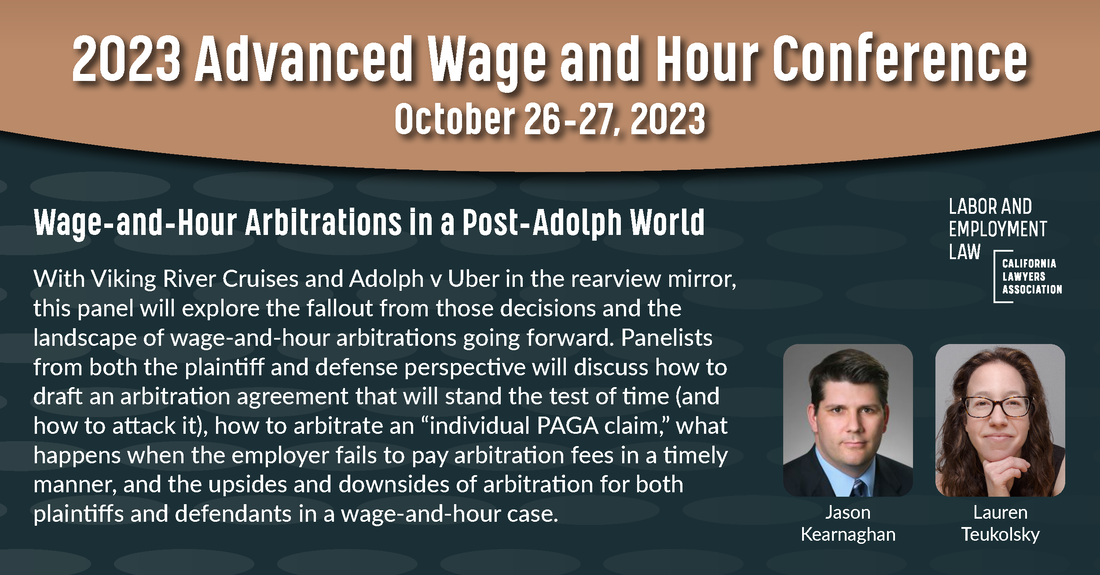 Lauren Teukolsky will speak on an October 26th panel at the California Lawyers Association’s (CLA) 13th Annual Advanced Wage and Hour Conference. The panel will explore the effects of Viking River Cruises and Adolph v Uber on the legal landscape, particularly with respect to wage-and-hour arbitrations. Ms. Teukolsky will represent the plaintiff’s perspective while co-panelist Jason Kearnaghan, a partner at Sheppard Mullin, will represent the defendant’s views.
The two panelists will explain how to draft and attack arbitration agreements, how to arbitrate individual PAGA claims, and the upsides and downsides of wage-and-hour arbitration for plaintiffs and defendants, among other topics. Ms. Teukolsky regularly discusses the latest employment law developments at conferences and panels. In September and October, Ms. Teukolsky shared insights on Viking River Cruises and Adolph v Uber for a trio of talks hosted by the Alameda County Bar Association, the Beverly Hills Bar Association, and the California Lawyers Association. Her commentary on the two cases has also been featured in articles by the Daily Journal, Bloomberg Law and Law.com. CLA is a nonprofit, voluntary bar association serving thousands of licensed attorneys throughout California. Its Labor and Employment Law Section serves as a networking and educational forum for California’s labor and employment lawyers and non-lawyers with an interest in the field. To register for CLA’s 13th Annual Advanced Wage and Hour Conference, click here. For more information about Teukolsky Law, click here.  Lauren Teukolsky’s “Wage and Hour Case Notes” were published in the March 2023 edition of the California Labor and Employment Law Review, describing six new decisions from California and U.S. appellate courts that affect wage-and-hour law. The column discusses arbitration agreements with wholesale PAGA waivers, California’s “outside salesperson” exemption, and the state’s first published appellate court decision to discuss Viking River’s impact on a motion to compel arbitration in a PAGA case, among other topics.
Wage-and-hour law is a dynamic field, with new appellate decisions that regularly reshape the legal landscape. Ms. Teukolsky is an expert in California wage-and-hour law and federal wage-and-hour law, and speaks frequently on wage-and-hour topics at national and state conferences. Her “Wage and Hour Case Notes” are published on a quarterly basis by the California Lawyers Association’s (CLA) Labor and Employment Law Section. CLA is a voluntary bar association. Its mission is to “promote excellence, diversity and inclusion in the legal profession and fairness in access to justice and the rule of law.” To read Ms. Teukolsky’s article in its entirety, click here. If you would like to speak with Ms. Teukolsky about a wage-and-hour matter, click here to get in touch. Law360 quoted Lauren Teukolsky in a February 28 article on the recent nomination of Julie Su to be the next Secretary of Labor. Su has served as Deputy Labor Secretary since 2021, helping oversee the Department of Labor. Before that, Su was head of California’s Labor and Workforce Development Agency and was considered a Labor Secretary candidate, though President Biden ultimately nominated Boston Mayor Marty Walsh for the position. Walsh is leaving to head the National Hockey League’s players’ union.
Under Walsh, the Labor Department supported organized labor and workers through a series of regulatory and legislative actions. If confirmed by the U.S. Senate, Su is expected to continue the Department’s pro-union and pro-worker stance while also stepping up federal enforcement in the areas of worker classification, independent contractor status, and wage and hour issues. Su is President Biden’s first Asian American cabinet secretary. Worker attorneys and workers’ advocates have voiced near unanimous support for Su’s nomination. Law360’s article reads as follows: “Lauren Teukolsky of California-based Teukolsky Law said she has known Su since at least 1998, when Teukolsky was a law student and Su was litigation director of the group now known as Asian Americans Advancing Justice Southern California. At the time, the two of them worked on California's Assembly Bill 633, which implemented wage protections for garment workers. ‘Julie's idea was to extend liability for the wages beyond the contractor, beyond the direct employer, to bigger companies that were higher up the food chain, including garment manufacturers and even, in some instances, garment retailers,’ Teukolsky said. ‘It really demonstrates how she is able to think creatively about a labor enforcement problem in a way that other advocates haven't necessarily thought of before,’ Teukolsky said. ‘She just has this ability to problem-solve and use a mix of legislation, advocacy, court rulings, advocacy in the courtroom, just to use all of these different tools as problem-solver.’” Teukolsky Law congratulates Julie Su on her historic nomination. To learn more, click here to read the Law360 article in its entirety.  Lauren Teukolsky’s “Wage and Hour Case Notes” were published in the November 2022 edition of the California Labor and Employment Law Review, describing six new decisions from California and U.S. appellate courts that affect wage-and-hour law. The column discusses summary judgment standards governing suitable seating cases, reverse auctions in PAGA cases, PAGA lawsuits following the settlement of individual Labor Code claims, and federal class certification standards.
Wage-and-hour law is a dynamic field, with new appellate decisions that regularly reshape the legal landscape. Ms. Teukolsky is an expert in California wage-and-hour law and federal wage-and-hour law, and speaks frequently on wage-and-hour topics at national and state conferences. Her “Wage and Hour Case Notes” are published on a quarterly basis by the California Lawyers Association. To read Ms. Teukolsky’s article in its entirety, click here. If you would like to consult with Ms. Teukolsky on a wage-and-hour matter, use this page to get in touch. Lauren Teukolsky Quoted in Law360 Article on Los Angeles Hotel Worker Protection Ordinance8/30/2022  Lauren Teukolsky was quoted in an August 26th article by Law360 about the Hotel Worker Protection Ordinance (HWPO) that recently went into effect in Los Angeles on August 12th. The ordinance seeks to protect Los Angeles’ hotel workers by mandating extra compensation when they are required to clean more than a certain amount of square footage in a given day. The ordinance also requires that they be provided with “panic buttons” given the high rates of sexual assault experienced by hotel workers.
The HWPO requires hotel employers with 45 or more guest rooms to pay their workers double-time rates for all hours worked in a day if they clean more than a certain amount of square footage. For hotels with 45-60 guest rooms, workers must be paid double-time rates if they exceed 4,000 square feet of floor space cleaned in an 8-hour day. At hotels with more than 60 quest rooms, employees must be paid double-time rates if they exceed 3,500 square feet of floor space cleaned. HWPO also requires that hotel employers keep a record of all workers, the rooms they cleaned, the square footage of those rooms and other information and maintain those records for three years. These requirements aim to ensure that hotel workers are fairly compensated for work that is often long and difficult. The articles states, “Lauren Teukolsky of Teukolsky Law, who has represented hotel workers, said the housekeeping job is onerous and often subject to scheduling changes. ‘You have situations where the hotel employer will require housekeepers to clean a very high number of rooms in their eight-hour shift, and it's very stressful,’ Teukolsky said. ‘It's very difficult for housekeepers to meet the quotas that are imposed,’” among other quotes from Ms. Teukolsky. If you are a hotel worker in Los Angeles and believe that your employer may be violating the Hotel Worker Protection Ordinance, click here to get in touch with Teukolsky Law. Lauren Teukolsky “Wage and Hour Case Notes” published in the California Labor & Employment Review7/25/2022 Lauren Teukolsky’s “Wage and Hour Case Notes” were published in the July 2022 edition of the California Labor and Employment Review, describing seven new decisions from California and U.S. appellate courts that affect wage and hour law. The column discusses whether trial courts may dismiss PAGA claims on manageability grounds, the proper application of the exclusive concurrent jurisdiction doctrine, a district court’s error in determining whether CAFA jurisdictional threshold was met, the proper application of the “ABC” test in jury instructions, and a good-faith defense to the imposition of waiting time penalties.
Wage-and-hour law is a dynamic field, with new appellate decisions that regularly reshape the legal landscape. Ms. Teukolsky is an expert in California wage-and-hour law, and speaks regularly on wage-and-hour topics at national and state conferences. If you would like to consult with Ms. Teukolsky on a wage-and-hour matter, use this page to get in touch. |
AuthorLauren Teukolsky is the founder and owner of Teukolsky Law, A Professional Corporation. Archives
June 2024
Categories
All
|
 RSS Feed
Teukolsky Law, A Professional Corporation, represents clients throughout California. Ms. Teukolsky is admitted to practice in the State of California, as well as the United States Supreme Court, Ninth Circuit Court of Appeals, Northern District of California and Central District of California. Disclaimer.
Copyright © 2017
Copyright © 2017